
Frozen Shoulder: Causes, Stages, and How to Treat It in Malaysia
Frozen shoulder is one of the most painful and misunderstood conditions we see. Here's how to recognise it, what stage you might be in, and which treatments actually move the needle.
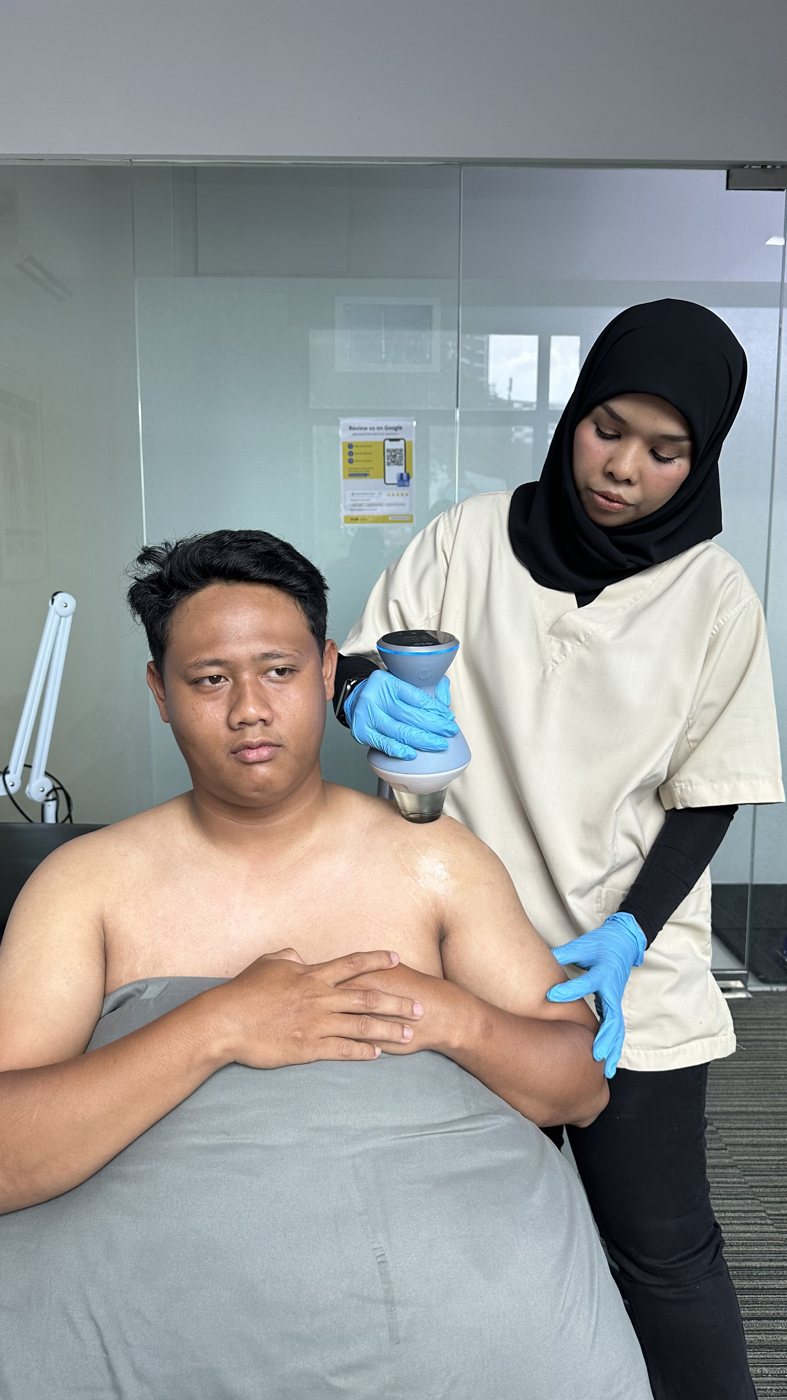
If your shoulder has been getting progressively stiffer over the past few months — to the point where you can't reach behind your back, fasten a bra, or sleep on your side — there's a good chance you have frozen shoulder (medically called adhesive capsulitis).
We see this condition almost every week at our Kelana Jaya centre. It's one of the most painful and longest-lasting musculoskeletal problems adults face — and one of the most misdiagnosed. Many patients are told they have "just a rotator cuff problem" and are sent away with painkillers for months while the shoulder gets worse and worse.
Here's what's actually happening and what you should do about it.
What is frozen shoulder?
Inside your shoulder is a capsule of connective tissue that surrounds the ball-and-socket joint. In frozen shoulder, that capsule becomes inflamed, then thickened, then scarred — physically shrink-wrapping the joint. Movement becomes painful and increasingly restricted.
It typically affects adults aged 40–60, more often women than men. It can come on after a minor injury, after a period of immobilisation (e.g. after surgery on the same arm), or — frustratingly — for no apparent reason at all.
Who's at higher risk?
- Diabetics — significantly elevated risk; about 1 in 5 people with diabetes will develop frozen shoulder
- Thyroid disorders — both hyper- and hypothyroidism
- Recent shoulder/breast surgery where the arm was immobilised
- Stroke patients with hemiplegic arm weakness
- Anyone who has had frozen shoulder on the other side — about 1 in 5 develop it on the second shoulder within 5 years
The three stages of frozen shoulder
This condition follows a fairly predictable arc. Knowing which stage you're in determines the best treatment.
Stage 1 — Freezing (2–9 months)
This is the painful stage. Sharp pain — often worst at night — appears gradually. The shoulder slowly stiffens. Patients in this stage often visit doctors who run X-rays (usually normal) and recommend painkillers. The condition is frequently misdiagnosed as rotator cuff strain at this stage.
Stage 2 — Frozen (4–12 months)
Pain often eases somewhat, but stiffness becomes severe. You'll struggle to lift your arm above shoulder height, reach behind your back, or perform daily tasks like dressing, driving and grooming. The shoulder feels "locked".
Stage 3 — Thawing (5–24 months)
Gradual return of range of motion. Most patients recover most of their function — but the entire process untreated can take 2–3 years from start to finish.
The good news: targeted physiotherapy can dramatically shorten this timeline and reduce long-term stiffness, especially when started in stage 1 or early stage 2.
How frozen shoulder is treated
Phase 1: Calm the pain
- Gentle range-of-motion exercises — never forced past pain, but maintaining what you have
- Manual therapy — joint mobilisation by a skilled physiotherapist
- Modalities — therapeutic ultrasound, TENS for pain control
- Ice for sleep — applied before bed to reduce night pain
- NSAIDs — useful short-term, prescribed by your GP
- Corticosteroid injections — often very effective in stage 1; we'll refer you to a sports doctor if appropriate
Phase 2: Restore movement
- Progressive stretching — guided, sustained, slightly into discomfort but never sharp pain
- Specific capsular mobilisations — hands-on techniques targeting the tight capsule
- Posture re-education — many frozen shoulders develop on the back of long-standing rounded-shoulder posture
- Heat before stretching — increases tissue extensibility
Phase 3: Rebuild strength
- Rotator cuff strengthening — once range of motion has returned, the muscles need rebuilding
- Functional retraining — practising the actions you need at work and home
- Long-term maintenance programme — to reduce recurrence risk on the same or opposite shoulder
What about MUA and surgery?
For severe, persistent cases that don't respond to 6+ months of good physiotherapy, options include:
- Hydrodilatation — saline injected into the joint capsule to stretch it (done under ultrasound)
- Manipulation Under Anaesthesia (MUA) — the surgeon forces the shoulder through full range while you're under general anaesthetic, breaking the adhesions
- Arthroscopic capsular release — surgical release of the tight capsule (rare; for refractory cases)
All of these still require physiotherapy afterwards — and aggressive rehab in the days following the procedure is critical to preserve the gains. We work alongside surgeons and sports doctors who perform these procedures.
What NOT to do
- Don't ignore it. Untreated frozen shoulder can leave permanent restriction in up to 15% of patients.
- Don't do "no pain, no gain" stretching. Forced movement can flare the inflammation and prolong recovery.
- Don't completely rest. Total avoidance of movement accelerates stiffness.
- Don't go to a chiropractor or untrained masseur for high-velocity "shoulder cracking". Risk of soft tissue tearing in this fragile capsule is real.
How long until I get better?
Honest answer:
- With consistent physiotherapy started in stage 1: Most patients see meaningful improvement within 3–4 months, near-full recovery within 9–12 months.
- Started in stage 2: Add 3–6 months to the above.
- Without treatment: 2–3 years, with up to 15% retaining some permanent stiffness.
If you suspect frozen shoulder — especially if you're diabetic, in your 40s/50s, or have noticed progressive stiffness over 1–3 months — the earlier we assess you, the simpler the recovery. WhatsApp us and we'll get you in for a clear assessment.
Have a question about your case?
WhatsApp us — describe your symptoms in your own words. We'll respond personally, usually within an hour.
 WhatsApp us
Related on Fisiouzma
Sports Injury Rehab
Return to sport stronger and faster with our evidence-based programme.
See service →Post-Surgical Rehab
Structured recovery after ACL, knee replacement and other surgeries.
See service →Plantar Fasciitis & Heel Pain
Why your heel hurts in the morning — and how to fix it.
Read article →The Office Worker's Survival Guide
How to prevent back and neck pain at your desk.
Read article →